Development version
This book follows the main branch and can describe features that are not in a release yet. The book for the latest release, v0.1.2, is here.
Contracts and formal verification
You will state properties of a design with invariant, requires, ensures and cover, and prove them for every input sequence with volt verify. You will read a counterexample and learn when bounded checking is enough and when you need a proof.
Before you start
-
Window: a terminal (how to open one) and your editor.
-
Folder: your
volt-projectsfolder. This chapter makes a new folder there,formal. Type this:cd ~/volt-projects -
Running:
volt verifyneeds three tools that Volt does not bring along: Yosys, SymbiYosys and an SMT solver.- Windows: these tools do not run on Windows by themselves. Start
Docker Desktop and wait for Engine running in its window
(Setup shows how).
Volt then runs the tools in a container. The container image is
downloaded the earliest time you run
volt verify: about 400 MB, which takes a few minutes. - macOS and Linux: Docker Desktop works the same way. Instead, you
can install the tools: the YosysHQ OSS CAD Suite has all three in one
download (
volt explain verify-setupsays where to get it).
volt doctorshows howvolt verifywill run: with Docker Desktop running, its line reads✓ verify — via Docker. - Windows: these tools do not run on Windows by themselves. Start
Docker Desktop and wait for Engine running in its window
(Setup shows how).
Volt then runs the tools in a container. The container image is
downloaded the earliest time you run
The output on this page was recorded with Volt 0.1.0 in PowerShell on
Windows 11, with Docker Desktop running the tools. On macOS and Linux,
paths are written with / instead of \.
Tests try some inputs, a proof tries all
The counter chapter tested a design: the test chose the inputs, cycle by cycle, and checked the outputs. A test shows that the design works for those inputs. It says nothing about the inputs nobody thought of.
A contract is a property written into the design itself, such as “the level never goes above 4”. Formal verification asks a solver, a program that searches through every possible input sequence, whether any of them breaks the contract. If one does, you get that input sequence as a counterexample, cycle by cycle. If none does, the property holds for every input the solver could choose.
Volt has four kinds of contract:
| Keyword | Means | May read |
|---|---|---|
invariant: | always true | ports and registers |
requires: | what the module expects from the module that uses it | ports |
ensures: | what the module promises in return | ports |
cover: | something that must be able to happen | everything |
volt verify checks them with formal verification. volt test checks
them too, while a test runs.
A buffer with four slots
Make a folder formal and go into it:
Type this:
mkdir formal
Type this:
cd formal
The design keeps count of the items in a buffer with four slots: push
puts an item in, pop takes one out. Create the file occupancy.volt
(as Setup shows):
Create this file: occupancy.volt
// Keeps count of the items in a buffer with four slots.

pub module Occupancy {
    in  clk   : clock
    in  push  : bool
    in  pop   : bool
    out level : u3
    out full  : bool
    out empty : bool

    reg level_r : u3 = 0

    on clk {
        if push && !pop {
            level_r <= level_r + 1
        } else if pop && !push {
            level_r <= level_r - 1
        }
    }

    level = level_r
    full  = level_r == 4
    empty = level_r == 0

    invariant: level_r <= 4
    cover: full
}
The two lines at the bottom are contracts:
invariant: level_r <= 4says that the register never holds more than 4.level_rhas 3 bits and could hold up to 7.cover: fullsays that the buffer can become full. A cover is not a promise that something always happens, but that it can happen at all; Covers below shows why that matters.
push and pop together leave the level as it is: one item goes in and
one comes out.
Check that Docker Desktop says Engine running, then verify the design. This takes a few minutes the earliest time, because of the download:
Type this:
volt verify occupancy.volt
You should see:
   Verifying occupancy.volt
note: SymbiYosys not found locally; running it in Docker (hdlc/formal:all)
note: downloading hdlc/formal:all (~404 MB, first use only; this can take several minutes)
note: downloaded hdlc/formal:all in 1m 18s
     [1/1] Occupancy (2 properties) ... FAIL (0.28s)
error[E5001]: contract violated
   ┌─ occupancy.volt:25:16
   │
25 │     invariant: level_r <= 4
   │                ^^^^^^^^^^^^ violated at cycle 3
   │
   = reason: the 'invariant' contract of module 'Occupancy' does not hold for every reachable state
   = counterexample: build\formal\occupancy_cex.vcd
   = help: open the counterexample with 'gtkwave' or 'surfer'
   = for more: volt explain E5001


    Finished 83.09s
    Failures:
      Occupancy.inv_0  E5001 contract violated at cycle 3
      Result 1 of 2 properties failed in 83.1s (16 jobs; bmc, depth 20)
        Next: volt explain E5001   (how to read a counterexample)
The two downloading notes appear once. This run took 83 seconds, almost
all of it for the download; the runs after it take about a second and a
half.
The invariant is violated. volt verify exits with code 6 and writes the
counterexample to build\formal\occupancy_cex.vcd. The summary line
counts two properties, the invariant and the cover, and says how the
search was made: bmc, depth 20 means the solver looked at the 20 clock
cycles after reset (the next sections explain the other modes). 16 jobs is the number of processor cores of the recording computer; your
number may differ.
Read the counterexample
A counterexample is a waveform, like the ones a failing test writes.
Open it in GTKWave (Tests and waveforms
shows how to install it), from the formal folder:
Type this (Windows, PowerShell):
gtkwave build\formal\occupancy_cex.vcd
Type this (macOS and Linux):
gtkwave build/formal/occupancy_cex.vcd
In GTKWave, open Occupancy in the tree at the top left and add the
signals to the view. Add smt_step from the top of the tree as well: it
numbers the clock cycles of the counterexample from 0.
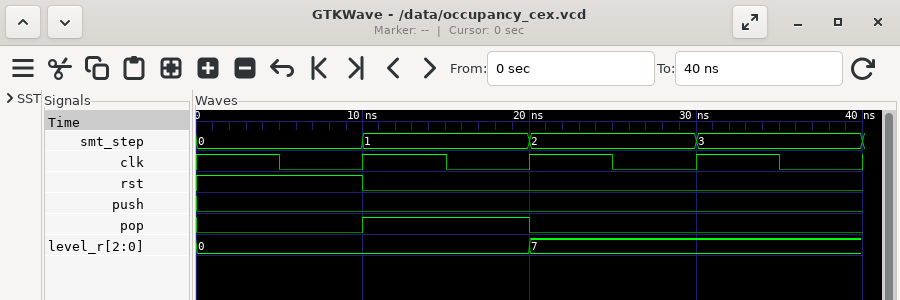
The screenshot was taken with GTKWave 3.3.121 on Linux (Debian 13). Read it cycle by cycle:
- Cycle 0:
rstis 1. The solver always starts from reset, solevel_ris 0. - Cycle 1:
popis 1 andpushis 0, while the buffer is empty. - Cycle 2:
level_ris 7.0 - 1wrapped around in 3 bits.
The invariant is checked at each clock edge, so the error names the edge after cycle 2: cycle 3. The design itself does what it says. The mistake is in what it allows: nothing stops a pop from an empty buffer, or a push into a full one.
New to hardware? Why a test would miss this
A test that pops an empty buffer would find this bug at once, but you have to think of writing that test. The solver does not think about what is sensible: it tries every input, including the ones a careful user would never send, and here it needed two cycles to find one. That is why formal verification is good at finding the cases nobody wrote a test for.
Requires and ensures
There are two ways to fix this. The design could ignore a pop from an
empty buffer. Or the module can say that it is never asked to do that,
and leave the duty to the module that uses it. That is what requires
is for. Replace the file:
Replace this file: occupancy.volt
// Keeps count of the items in a buffer with four slots.

pub module Occupancy {
    in  clk   : clock
    in  push  : bool
    in  pop   : bool
    out level : u3
    out full  : bool
    out empty : bool

    // The module that uses Occupancy promises these.
    requires: !(push && full)
    requires: !(pop && empty)

    reg level_r : u3 = 0

    on clk {
        if push && !pop {
            level_r <= level_r + 1
        } else if pop && !push {
            level_r <= level_r - 1
        }
    }

    level = level_r
    full  = level_r == 4
    empty = level_r == 0

    invariant: level_r <= 4
    ensures: prev(push) && !prev(pop) -> (level as u4) == prev(level) + 1
    cover: full
}
What changed:
requires: !(push && full)andrequires: !(pop && empty): no push while the buffer is full, no pop while it is empty. WhileOccupancyis verified, these are taken as given: the solver chooses no input that breaks them.ensures: ... -> ...is a promise about the outputs.a -> breads “ifa, thenb”.prev(x)is the valuexhad one cycle earlier, andprev(x, 2)two cycles earlier. The line says: after a cycle with a push and no pop, the level is exactly one higher than it was.level as u4makeslevelone bit wider, for the reason below.
An addition keeps its carry: prev(level) + 1 is a 4-bit value, because
3 bits plus one can need a fourth bit (7 + 1 = 8). Compared with the
3-bit level, the comparison could drop that carry, wrapping at 3 bits,
or keep it, and the two answers differ when the sum does not fit. Volt
does not guess: written as level == prev(level) + 1, the line is error
E2031, and the error offers both ways to write it:
level == (prev(level) + 1)[2:0] as u3keeps the low 3 bits of the sum: it wraps at 3 bits, so 7 + 1 counts as 0;(level as u4) == prev(level) + 1widenslevelto 4 bits: it keeps the carry, so 7 + 1 is 8.
Here the carry is kept: the level counts items and never wraps, and the
ensures should say so.
Type this:
volt verify occupancy.volt
You should see:
   Verifying occupancy.volt
note: SymbiYosys not found locally; running it in Docker (hdlc/formal:all)
     [1/1] Occupancy (3 properties, 2 assumed) ... ok (0.26s)
    Finished 1.28s
        Note 2 assumption(s) about the environment, not verified: Occupancy.req_0, Occupancy.req_1
      Result 3 properties verified in 1.3s (16 jobs; bmc, depth 20)
All three properties hold. The Note line lists the two requires:
they were assumed, not checked, because nothing in this file uses
Occupancy. When another module uses it, volt verify on that module
checks them there, as properties of the module that has to keep them.
Covers: can it happen at all?
A requires that is too strict makes every check pass for a bad reason.
Suppose the upper requires read requires: !push: the solver may then
never push, the buffer stays empty, and the invariant holds, without
saying anything about a buffer that is in use. A cover catches this.
Verify again in cover mode:
Type this:
volt verify --mode cover occupancy.volt
You should see:
   Verifying occupancy.volt
note: SymbiYosys not found locally; running it in Docker (hdlc/formal:all)
     [1/1] Occupancy (3 properties, 2 assumed) ... ok (0.20s)
    Finished 1.20s
        Note 2 assumption(s) about the environment, not verified: Occupancy.req_0, Occupancy.req_1
      Result 3 properties verified in 1.2s (16 jobs; cover, depth 20)
In cover mode the solver searches for a way to reach each cover within
the depth. It found one for cover: full, so the buffer can fill up
while the requires hold. With requires: !push in place of the upper
requires, the same command reports the cover as an error:
You should see (with requires: !push):
In cover mode the error means “not reached within the depth”: the solver
searched the 20 cycles of the depth and found no way to make full
true; the cycle in the message is the last one it searched. The words
of the message are the ones used for a broken property (“violated”,
“does not hold”), and no counterexample file is written, although the
help line names one; volt explain E5001 describes both modes. Run
--mode cover whenever you add or change a requires.
Twenty cycles, or every cycle
So far volt verify ran in its default mode, bmc (bounded model
checking): the solver looked for a counterexample within 20 cycles after
reset. That is enough for Occupancy, which reaches each of its levels
within a few cycles. It is not enough for a design that needs more
cycles to go wrong.
This module gives a pulse every 25 cycles, and has a bug: it counts to
25 instead of 24, so the count reaches 25 for one cycle. Create
divider.volt:
Create this file: divider.volt
// Gives a one-cycle tick every 25 clock cycles.

pub module Divider {
    in  clk  : clock
    out tick : bool

    reg count_r : u5 = 0

    on clk {
        if count_r == 25 {
            count_r <= 0
        } else {
            count_r <= count_r + 1
        }
    }

    tick = count_r == 24

    invariant: count_r < 25
}
Type this:
volt verify divider.volt
You should see:
   Verifying divider.volt
note: SymbiYosys not found locally; running it in Docker (hdlc/formal:all)
     [1/1] Divider (3 properties) ... ok (0.24s)
    Finished 1.28s
      Result 3 properties verified in 1.3s (16 jobs; bmc, depth 20)
Every property holds, because the count reaches 25 after more than 20 cycles. The design has three properties although you wrote one: for a counter, Volt adds an upper bound and a cover of its wrap by itself.
A passing bmc run says: no counterexample within 20 cycles. To know
about every cycle, ask for a proof:
Type this:
volt verify --mode prove divider.volt
You should see:
   Verifying divider.volt
note: SymbiYosys not found locally; running it in Docker (hdlc/formal:all)
     [1/1] Divider (3 properties) ... unknown (0.26s)
error[E5002]: contract not proven: the induction step failed
   ┌─ divider.volt:19:16
   │
19 │     invariant: count_r < 25
   │                ^^^^^^^^^^^^ not inductive at depth 20
   │
   = reason: no counterexample exists within 20 cycles from reset, but the induction step starts from an arbitrary state — possibly unreachable — and the 'invariant' contract of module 'Divider' fails from there (sby status UNKNOWN)
   = note: induction trace (may start from an unreachable state): build\formal\divider_induct.vcd
   = help: try a larger --depth, or add an invariant that makes the property inductive
   = for more: volt explain E5002


    Finished 1.29s
    Failures:
      Divider.inv_0  E5002 not proven (induction step failed)
      Result 0 of 3 properties failed, 1 not proven in 1.3s (16 jobs; prove, depth 20)
        Next: volt explain E5002   (why a true property can fail induction)
--mode prove uses induction: if the property held for 20 cycles in a
row, starting anywhere, does it hold in the next one? Here it does not,
so the proof fails, and the command exits with code 7, “not proven”. That
is not yet a bug: the solver may have started from a state the design
can never reach. The help line names the two ways on. A larger depth
looks further:
Type this:
volt verify --depth 30 divider.volt
You should see:
   Verifying divider.volt
note: SymbiYosys not found locally; running it in Docker (hdlc/formal:all)
     [1/1] Divider (3 properties) ... FAIL (0.27s)
error[E5001]: contract violated
   ┌─ divider.volt:19:16
   │
19 │     invariant: count_r < 25
   │                ^^^^^^^^^^^^ violated at cycle 27
   │
   = reason: the 'invariant' contract of module 'Divider' does not hold for every reachable state
   = counterexample: build\formal\divider_cex.vcd
   = help: open the counterexample with 'gtkwave' or 'surfer'
   = for more: volt explain E5001


    Finished 1.34s
    Failures:
      Divider.inv_0  E5001 contract violated at cycle 27
      Result 1 of 3 properties failed in 1.3s (16 jobs; bmc, depth 30)
        Next: volt explain E5001   (how to read a counterexample)
Now bmc finds the bug, at cycle 27. Fix the comparison,
count_r == 24:
Replace this file: divider.volt
// Gives a one-cycle tick every 25 clock cycles.

pub module Divider {
    in  clk  : clock
    out tick : bool

    reg count_r : u5 = 0

    on clk {
        if count_r == 24 {
            count_r <= 0
        } else {
            count_r <= count_r + 1
        }
    }

    tick = count_r == 24

    invariant: count_r < 25
}
Type this:
volt verify --mode prove divider.volt
You should see:
   Verifying divider.volt
note: SymbiYosys not found locally; running it in Docker (hdlc/formal:all)
     [1/1] Divider (3 properties) ... ok (0.22s)
    Finished 1.26s
      Result 3 properties verified in 1.3s (16 jobs; prove, depth 20)
Proved: the invariant holds in every cycle, however long the design runs. When to use which mode:
bmc(the default) finds bugs that happen within--depthcycles of reset, and gives a counterexample. It is enough when the design reaches all of its states within that depth.--mode proveshows that a property holds forever. Use it for counters, timers and anything else that takes many cycles to come back to where it started. When it says “not proven”, try a larger--depth, or add aninvariantthat rules out the states the solver started from.--mode covershows that the covers can be reached, so that a passing proof is not passing because nothing can happen.
You are in the formal folder.
Coming from SystemVerilog? Contracts become SVA
volt build --emit=sva writes the contracts as SystemVerilog
assertions in build/formal/, in a checker module with a bind. An
invariant becomes an assert property with @(posedge clk) disable iff (rst), a requires becomes an assume property while the module
itself is verified, prev(x, N) becomes $past(x, N), and a -> b
becomes a |-> b. volt verify writes the SymbiYosys script for you
and maps a failure back to the line of the contract. There are no
sequences (##) and no liveness properties; see
Known limitations.
What we learned
invariant,requires,ensuresandcoverare written into the module;prev(x)reads the value of the previous cycle,a -> breads “if a, then b”.volt verifyexits with code 6 and writes a counterexample waveform when a contract can be broken; read it cycle by cycle.- A
requiresis assumed while its module is verified and checked where the module is used. --mode covershows that the covers can happen, so a too strictrequiresdoes not go unnoticed.bmclooks--depthcycles deep;--mode provecovers every cycle, and says “not proven” (code 7) when induction is not enough.
Next: the chapters after this one in the Tutorial are planned. The Cookbook has recipes that build on this chapter and the previous one, such as Reset synchronizers.